Feedback
A really good course, right in line with our real-world practice, thanks to the role-play scenarios.
— Frédéric Delépine, Works Supervisor
Renewed self-confidence in a day-to-day where I felt too often put down.
— E. C., Nurse
“We wanted to thank you for the quality of your advice over the last two sessions. All our drivers at Orige Partners were able to take away different useful aspects for their daily work, and some of them have already put certain lessons into practice.”
— Alexandre De Montesquieu, Orige Partners
“Useful, concrete, enlightening. Jérôme’s ability to engage everyone while teaching the fundamentals of self-defence is exceptional. It’s very rare for me to take part in a course this well built and thought through down to the smallest detail. An experience I’d repeat without hesitation!”
— Roberto Sassu, Teacher
Stop improvising Aggression is no longer the exception
Incivility, threats, physical incidents: aggression has settled into professional daily life. The human cost is huge; so is the cost to the organisation — sick leave, turnover, a degraded climate, legal liability. Your teams are facing this already — train them to do it safely.
Verbal conflict
The rising tone, the insult, the threat. The window where everything can still be defused, if you know what to say — and what to stop saying.
Physical conflict
Dialogue has failed, the individual is highly aggressive or actively resisting. This is where you need effective, legal, proportionate moves.
The relationship worth preserving
Patient, member of the public, client or spectator: the person in front of you is still a person. Enforcing the rule while preserving the relationship is the heart of the method.
New reflexes for your teams
Concrete reflexes to defuse, protect yourself, act as a team and recover after the incident — a field method that holds, even under pressure.
Defuse
Apply the 5 universal rules of calm communication and the 4 arts of tactical communication. Speak without wounding, assert yourself without attacking.
Protect yourself
Adopt a safety posture, a discreet guard and emergency protection, both static and in motion. Perceive how the danger is evolving.
Act as a team
Follow a shared protocol: contain, separate, remove, break free from a grab. No blows, no joint locks — even with vulnerable individuals.
Hold and recover
Stay clear-headed under stress, protect yourself psychologically and debrief after the incident, so the aggression leaves no lasting trace.
A two-part journey built on your own scenarios
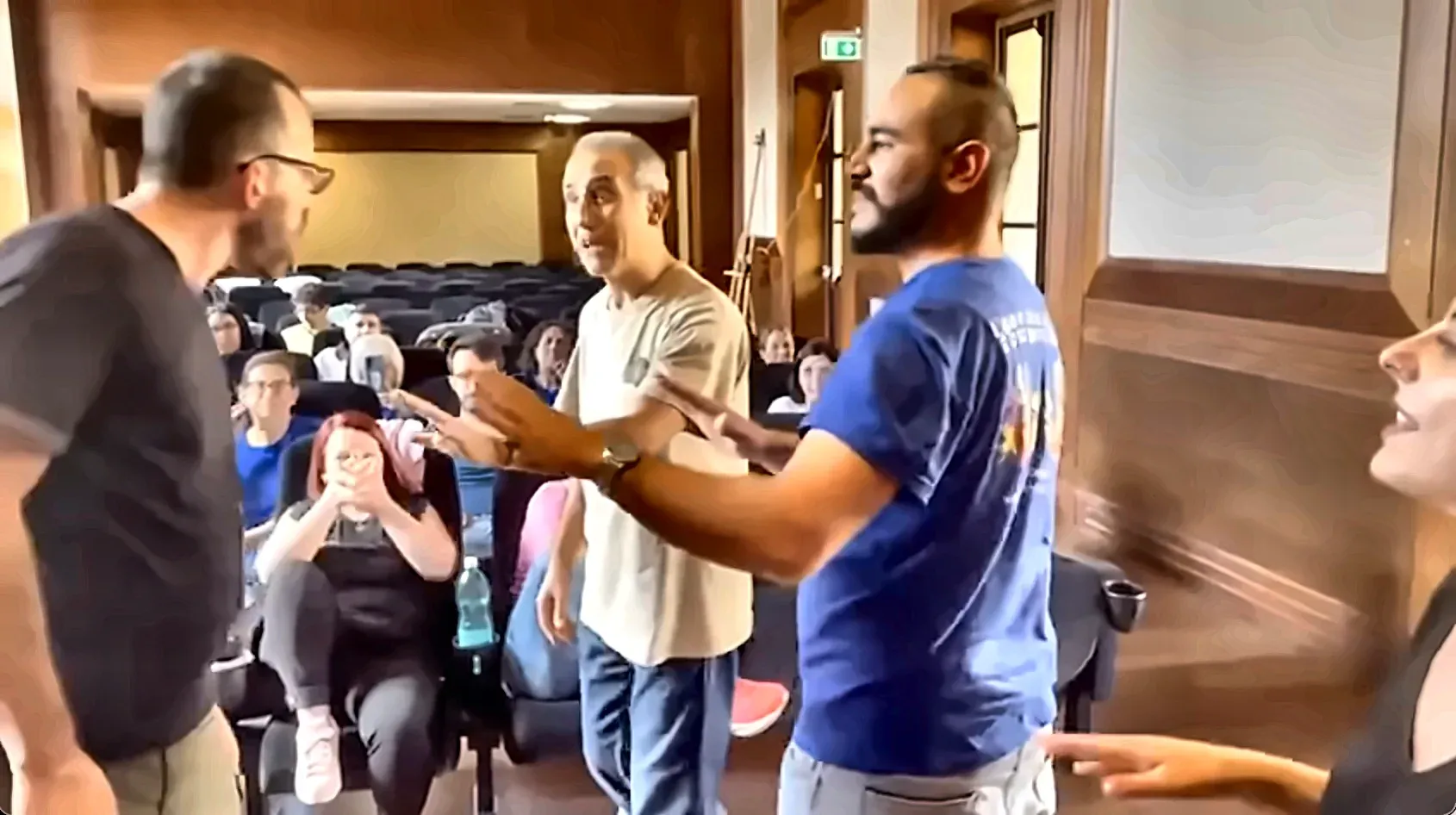
Each session starts with an interview with your managers to define the framework and objectives, and is built on ultra-realistic, safe role-play drawn from your own reality.
Day 1, Defuse — verbal conflict
Conflict dynamics · shared resolution protocol · the 5 rules of calm communication · the 4 arts of tactical communication · psychological protection · safety postures. Role-play throughout the day.
Day 2, Act — physical conflict
Stability work · emergency protection · shared emergency protocol · impact-free intermediate-force tools (fabric control) · contain, separate, remove, break free. Scenarios, quizzes and group debrief.
+ the mental thread throughout
Stress management runs through both days: TOP© tools to regain control in a tense situation. To go further, the TOP© Initial Training naturally continues this journey.
One method three fields of application
The principles don’t change; the scenarios, the typical aggressor profiles and the legal framework do. The course is systematically adapted to your reality.
Healthcare, hospitals and social services
Agitated patients, families at breaking point, emergency rooms, psychiatry, geriatrics. Protecting caregivers without damaging the care relationship, in absolute respect of patient dignity.
Public safety, municipal police
Managing resistant individuals, often vulnerable: homeless people, teenagers, seniors, psychiatric patients. Emergency negotiation and impact-free intermediate force.
Business, reception and services
Counters, transport, retail, administration: aggressive clients, repeated incivility. Teams that understand each other, clients who come back.