Managing aggressive patients and their families
A cardiology ward, a weekday evening. A woman stays at her husband’s bedside well after visiting hours end. A nurse approaches, gently tells her it’s late, that she can come back tomorrow.
She explodes. She grabs her husband’s monitor and throws it at him, the device shatters. The nurse calls for backup, security, the police. Backup arrives; the police don’t. The woman explodes a second time and throws the second monitor, belonging to the other patient in the same room.
No one manages to contain her. The toll: two monitors broken out of eight. The ward now runs at 6 operational beds instead of 8, over what started as nothing more than an end-of-visit conversation.
A department that stops, a mission that retreats
What this story shows is that an altercation is never an isolated incident. It interrupts the department, sometimes for the evening, sometimes for much longer — a degraded department means patients less well cared for, an already-stretched team even more so, and a facility absorbing the shock long after the crisis itself has passed.
And this kind of event is nothing exceptional. Caregivers are the first responders in 61% of violent incidents in healthcare settings (source: ONVS, French National Observatory of Violence in Healthcare). They aren’t security officers, nor police trained in crowd control. They’re nurses, doctors, care assistants, on the front line, without having been prepared for it.
The hospital, last sanctuary
The hospital has a distinctive feature few institutions share: it cares for everyone, unconditionally. Regardless of status, nationality, responsibility in the events, or even the person’s behaviour at the time, the hospital remains, as a last resort, a sanctuary. That’s exactly what gives it its strength, and what makes it vulnerable: that door stays open to all forms of distress, including those expressed through violence.
Protecting the hospital’s functioning isn’t, then, just one logistical concern among others. It’s protecting its very purpose — its capacity to stay open and provide care, whatever arrives at its door.
Professionals of empathy, put to the test
Caregivers are, by vocation and training, professionals of empathy. It’s the heart of their job: welcoming distress, listening to it, responding to it. But empathy has a cost, and under prolonged tension — an overloaded ward, a difficult night, one verbal attack too many — that capacity erodes. It’s not a lack of professionalism: it’s a human resource, one that can be exhausted like any other.
That’s the whole challenge: giving teams the means to preserve that empathy even in moments when it’s put to the test, rather than watching it collapse at the worst possible moment, as in the cardiology episode.
Why conflict management belongs in continuing education
For all these reasons — the frequency of incidents, the first-responder role that falls to caregivers, the need to preserve the hospital’s functioning and mission, the preservation of empathy under tension — conflict management isn’t a side module in doctors’ continuing education. It’s a skill as central as clinical technique.
The continuing education course on managing aggressive, agitated or violent patients directly answers this need, for staff working in environments where tension rises fast: hospitals, emergency departments, nursing homes, social services, outpatient care.
What the course actually aims to achieve
In the opening anecdote, it wasn’t the nurse’s first response that was the problem — it was the absence of a protocol for everything that followed: no one to spot the rising tension before it erupted, no one to contain the situation when backup arrived, no team coordination once the crisis was underway.
The course works precisely on these blind spots: spotting the first signs of an escalation before it becomes unmanageable, using verbal, postural and environmental de-escalation techniques, reducing the risk of aggression and the stress load that comes with it, facing a hostile or distressed relative without making the situation worse, and more broadly, building a safer care environment for patients and teams alike.
A recognised ECM accreditation in Italy
The course has been accredited by AGENAS on several occasions, through official providers or directly via the ARS (Regional Health Authorities). It qualifies for ECM training credits, counted towards mandatory professional development.
Format
- Format: in person
- Duration: 8 hours
- ECM credits: 11 minimum
- Participants: 20 maximum per group
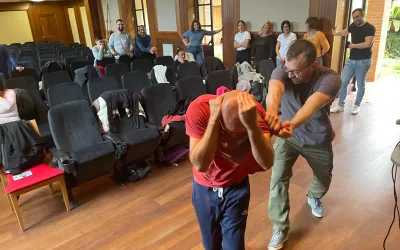
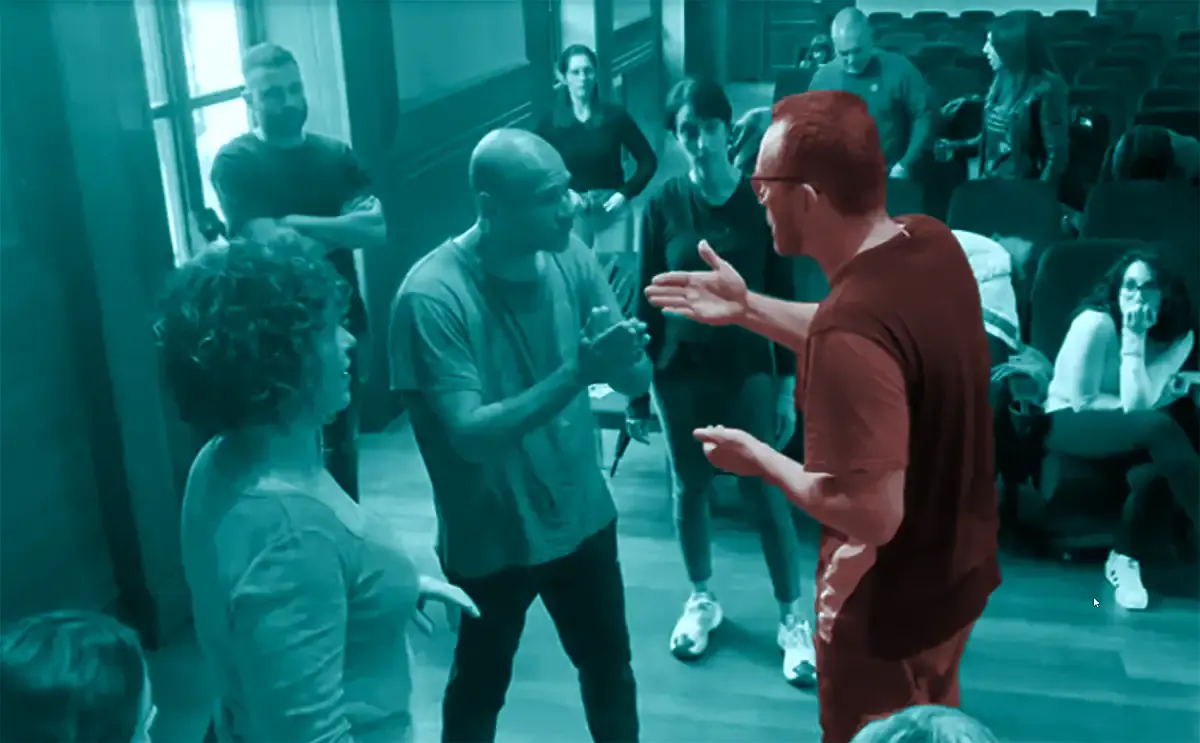
We deliberately keep groups small. Beyond that, role-play loses realism and everyone’s attention wanes — and it’s exactly in that role-play that people learn to react the way the cardiology team would have needed to that evening.
What we work on during these 8 hours
- The psychology of violence applied to the care context
- Verbal containment strategies and emotional management, both one’s own and the other person’s
- Practical simulations: role-play and analysis of real cases, no theory in a vacuum
- Effective communication in critical situations, through tactical empathy
- Team coordination as a situation grows
- Physical restraint using clothing control, never resorting to a blow
The questions I’m asked most often
Is the course recognised everywhere in Italy?
Yes, through AGENAS, regardless of the facility.
How do you get the certificate?
Yes, via the platform of the regional health authority that accredited the session.
Is it really practical, or mostly theory?
Practice is at the heart of the course — guided exercises and realistic scenarios, like the one described above.
Does the course suit all teams?
Yes, it’s designed to adapt to teamwork, regardless of the care environment.
Does it also address the issue of family, visitors and carers?
We deal with this case specifically, stepping in as soon as an aggression is brewing, always within the hospital’s framework and mission.
How do I organise a session?
Contact me to organise a course at your hospital or find out about upcoming dates.